

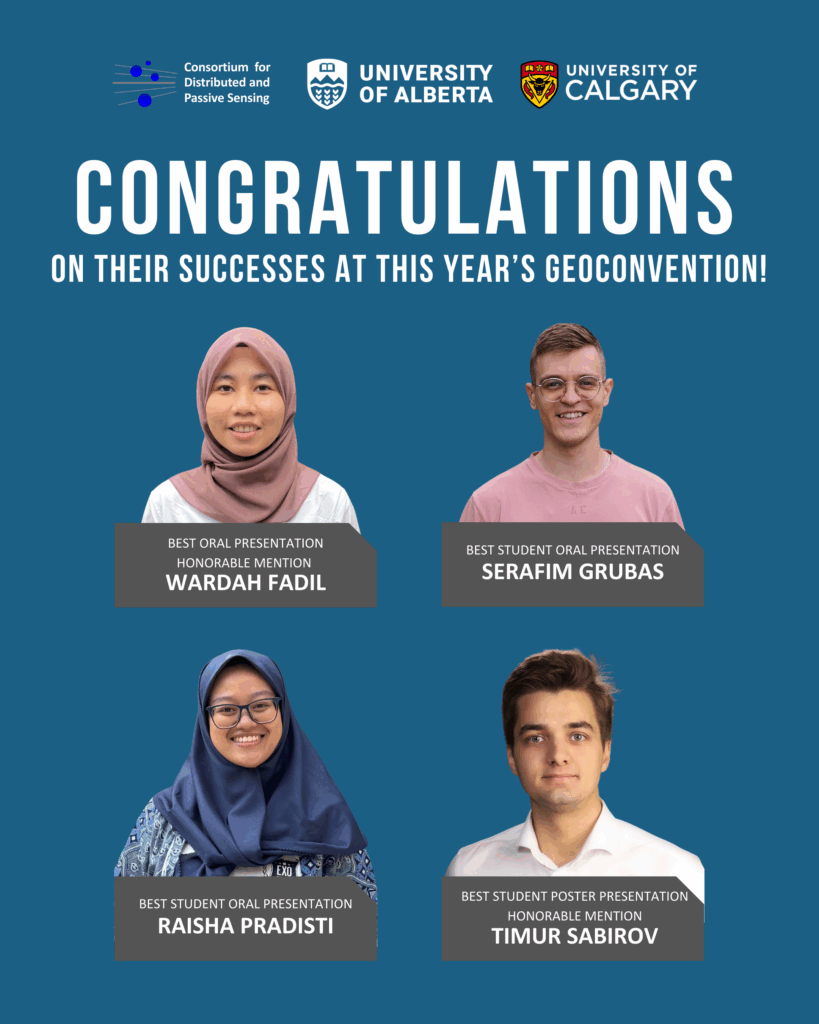
Four Highly Qualified Personnel (HQPs) from the Consortium for Distributed and Passive Sensing (C-DaPS) were recently honored with major awards for their presentations at GeoConvention.
Wardah, Serafim, and Mirko’s presentation won the Best Oral Presentation, Honorable Mention. Fadil introduced an additional detection classification step based on an analysis of the time-frequency attributes automatically calculated by Cluster Analysis of Trimmed Spectrograms (CATS). This refinement reduces the total CATS potential events by 93% (from 35,698 to 2,278) and increases the precision to 7.5%, with only a slight decrease in recall to 96.6%.
Serafim and Mirko’s presentation was elected the champion of the Best Student Oral Presentation. Their talk, titled “Three-component denoising of earthquake signals with CATS-3C”, proposed a modification to the CATS denoising method for joint 3C denoising (CATS-3C), which implements a shared binary mask across the three components. Experiments indicated that CATS-3C outperformed the original CATS and bandpass denoising methods in reconstructing weak signals through the mask from the strong components.
Raisha and Mirko’s presentation was also elected the champion of the Best Student Oral Presentation. Their presentation, with the title “Hindcast simulations of M ≥ 4 events and anticipated ground shaking for induced seismicity in Montney, British Columbia”, hindcasts the likelihood of magnitude M ≥ 4 events using the Monte Carlo simulation based on the estimated Gutenberg-Richter (GR) parameters obtained from the observed catalog. They propose that the rates and probability occurrences of the moderate magnitude events were trickier to simulate due to the inherent uncertainty associated with their rare observed occurrence.
Timur and Juliana’s poster presentation won the Best Student Poster Presentation, Honorable Mention. Their work presented an enhanced fracture propagation model to simulate hydraulic fracturing processes, leveraging insights derived from low-frequency distributed acoustic sensing (LF-DAS) data. The model integrates coupled flow and geomechanical simulation to analyze the complex interactions of stress and strain during hydraulic fracturing stimulation. The main focus of their work is modeling various stress regimes and the complexities of multiphase fluid flow.
Wardah Fadil worked at the Consortium from 2023 to 2025. She is now a Geophysical Data Specialist at ESG Solutions with eight years of experience in seismic monitoring and earthquake source analysis. She holds a PhD in Observational Seismology, where her research focused on earthquakes, tectonics, and seismic hazard in Southeast Asia. She now specializes in seismic monitoring solutions for CCUS and emerging energy applications.
Serafim Grubas is a PhD Candidate in Geophysics at the University of Alberta, supervised by Prof. Mirko Van der Baan. His current research focuses on developing a software for robust earthquake analysis (detection, denoising, picking) using a combination of traditional and machine-learning approaches. Serafim received his BSc (2019) and MSc (2021) in Geophysics at the Novosibirsk State University (Russia), where his previous research focused on using neural networks to boost seismic processing procedures and modeling seismic-wave traveltimes.
Raisha Pradisti is a PhD student in Geophysics at the University of Alberta, studying under Prof. Mirko van der Baan’s supervision. She received her BSc in Geophysical Engineering from Institut Teknologi Bandung in Indonesia in 2019. She started as an MSc student in Fall 2021 before transferring to the PhD program in Fall 2023. She is working on probabilistic seismic hazard analysis (PSHA) for induced seismicity in northeastern British Columbia.
Timur Sabirov is an MSc Candidate in Petroleum Engineering from the Department of Civil and Environmental Engineering at the University of Alberta. Working under the supervision of Dr. Juliana Leung, his research focuses on coupled flow-geomechanical simulation of hydraulic fracturing and analyzing Low-Frequency Distributed Acoustic Sensing (DAS). He received his BSc degree in Petroleum Engineering at Saint-Petersburg Mining University (St. Petersburg, Russia).
The Consortium for Distributed and Passive Sensing (C-DaPS) was established in 2010, jointly hosted by the University of Alberta and the University of Calgary. For over a decade and a half, we have maintained a proven track record of strategic, world-class research and award-winning training. We are dedicated to finding creative solutions to some of the most daunting challenges faced by energy industries. Our interdisciplinary research spans several key areas, including passive seismic data acquisition, processing, and advanced interpretation, geomechanics and induced seismicity, machine learning, and distributed acoustic sensing (DAS). Recently, we have been looking to expand our expertise into areas such as reservoir engineering and Satellite-based InSAR.
Once again, congratulations to Wardah, Serafim, Raisha, and Timur on their success at this year’s GeoConvention! Their hard work paid off. They will travel to Calgary early next year to officially receive their awards.